
Howell City Directory Collections
Howell's historical directory evidence is county-wide, not a single township shelf. That matters because a useful Howell city directory may be filed as Monmouth County, a nearby city, a farm-and-business volume, or a microfilm series. Start with the title and year, then record where the copy or reel was consulted. The holdings below are documented collection routes. They do not mean that every volume contains every Howell settlement or every family.
| Collection | Years | Where Held | Access |
|---|---|---|---|
| J.D. Lant, Monmouth County Directory | 1875 | County historic-sites bibliography and library or microfilm finding aids | Locate the documented volume through a library or finding aid |
| Boyd's Monmouth County directory | 1898, 1904; related 1898-99 and 1904-05 series | NJ Historical Society, Rutgers, and Asbury Park microfilm routes | Verify the volume and reel before relying on its scope |
| Farm Journal Illustrated, Monmouth County | 1914 | County bibliography and genealogy database or library routes | Library or licensed collection access |
| Monmouth County city directories | 1885-86, 1891, 1897-1901, 1905-17, 1920-21 | NJ Historical Society, ten microfilm rolls | Microfilm research |
| “Monmouth County and its Cities” | 1883-1970 | Asbury Park Public Library collection described by Rutgers | About 25 reels, with reel order to confirm |
| HeritageQuest city directories | 1822-1995 | Monmouth County Library database | Licensed database, availability to confirm |
| FamilySearch U.S. city and business directories | circa 1749-circa 1990 | Online FamilySearch collection | Name, occupation, address, and some image access |
The gaps are meaningful. Rutgers describes the 1883-1970 sequence as out of order, and no source establishes a first or last directory printed only for Howell. A blank year may be a missing reel, an unfilmed settlement, or an unindexed page. Note: Record the title, publication year, page or reel, and the access location before treating a directory result as family evidence.
Howell Directory Year Runs
The sequence begins with the documented 1875 Lant county directory, moves through Boyd's 1898 and 1904 volumes, and includes the 1914 farm-and-business directory. The NJ Historical Society runs then supply selected years from 1885 through 1921. These are not interchangeable editions. A farm directory can preserve acreage, a rural route, or a family relationship that a town directory does not print, while an annual run can show a move between adjacent years.
- 1875: J.D. Lant's county directory is the earliest documented starting point.
- 1883-1970: the Asbury Park microfilm sequence covers county and city material, but its reels are out of order.
- 1885-1921: NJHS preserves selected Monmouth County annual runs on ten rolls.
- 1914: the Farm Journal volume adds a rural farm-and-business pattern to the chronology.
Publication coverage is a shelf question, not a promise of a listing. Ask for the reel sequence and catalog record when a year matters. The county sequence is the sound chronology for Howell, rather than an unsupported claim that a particular volume was a complete township census.
Howell Directory Shelf Access
The county library's Historical Room is at Headquarters in Manalapan. Established in 1998, it has more than 1,400 secure, non-circulating items, including directories, local histories, scrapbooks, and genealogy material. Its catalog location is “NJ-Room,” so the material must be used in the library. The Howell branch provides reference help, local-history and government material, public internet, and research databases; check the library research page for the current access rules.
The Monmouth Historical Association genealogy resources add a second channel for directories, church records, cemetery transcriptions, Bibles, obituaries, family files, and historic-house clues.
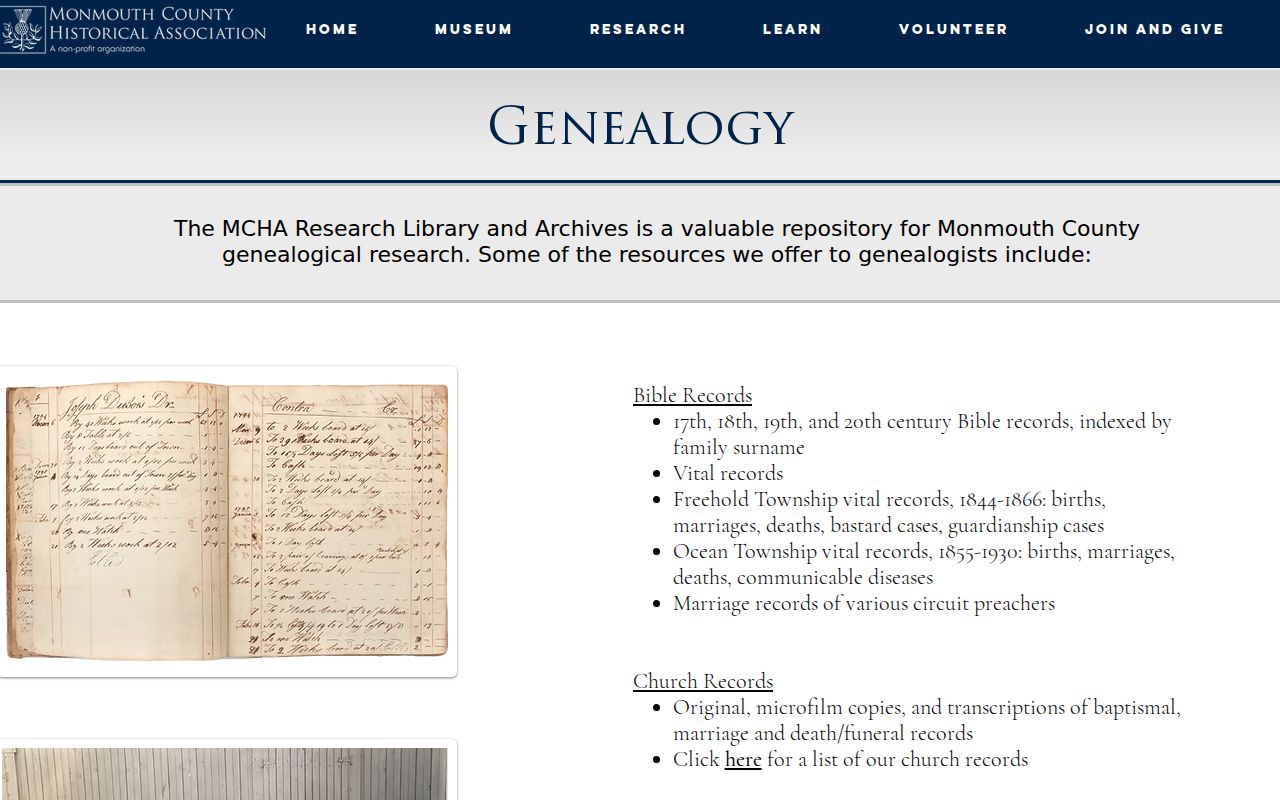
MCHA's Research Library in Freehold is appointment-based, has more than 1,000 manuscript collections, and may charge a small in-house research fee. It is a practical fallback when the library shelf supplies a directory surname but not the family event that explains a disappearance.
Note: Database licenses and research-room access can change, so confirm the current route before making a library or appointment visit.
Reading Howell Directory Entries
A Howell directory entry is a printed observation from one edition, not a modern identity profile. Read what appears on the page without filling gaps from memory. A typical entry can show the surname and given name, spouse in parentheses, occupation or business, a street and house number, and a boarding, ownership, non-owner, or widow notation. Rural entries may replace a house number with a route, crossroads, post office, acreage, or township locality.
| Publication point | Title, year, page, reel, or image reference for the copy used |
|---|---|
| Printed person | Full name, spouse or household notation, and suffix exactly as printed |
| Place clue | Street and number, rural route, crossroads, post office, or nearby locality |
| Activity clue | Occupation, business, acreage, or farm reference when the volume prints it |
| Editorial marks | Owner, non-owner, boarding, widow, and abbreviation-key notation when present |
| Context | Adjacent names on the street or page, which may supply a family or neighborhood check |
Preserve the key used by that volume. “Jr.,” “wid.,” “h,” “r,” and “bds” are clues only after the edition's own abbreviation list is checked. The documented 1914 Farm Journal pattern can combine name, family relationship, farm ownership or acreage, occupation, rural route, and locality. It still requires viewing the actual entry before quoting one.
- Criss-cross directory
- An address or street-order arrangement used to work backward from a location to a listed occupant.
- Householder index
- A name arrangement centered on the head of a household or listed household contact, not a full census of everyone present.
- Abbreviation key
- The edition's own explanation of its shortened marks and street terms. Save it with the entry image rather than guessing an expansion.
Howell Directory Address Search
Criss-cross work reverses the usual lookup. Normalize a current address against a parcel or street map, then search the address, street, rural route, or crossroads in the county runs. Howell's older entries may use an historic place label rather than the present street name. Try Adelphia, Bethel, Southard, Jerseyville, Green Grove, Ramtown, Squankum, Freewood Acres, and Ardena beside the current wording.
Howell directory runs are particularly vulnerable to a false negative when the family used a post office or route. The 1854 change from Green Grove to Jerseyville is one documented reason to search both names. A route number can matter more than a street number in a rural record. Compare the printed locality with the deed or parcel description before deciding two entries describe different places.
Note: Preserve the historic place term with the normalized address, because either wording may control a catalog or microfilm search.
Tracing a Howell Directory Household
Trace a household in a Howell directory as a dated sequence. A name alone is not enough, especially where a surname is common. Put the address, spouse notation, occupation, locality, and adjacent names beside each year. Then test the sequence against a census released for that period. Federal census images are subject to a 72-year release rule, and 1950 was the latest released census at the research date. Census geography and address language can differ from a directory, so the comparison is a check, not an automatic match.
- Start with a current street address and parcel or legal description. Keep the owner mailing address separate from the property location.
- Search the current and earlier owner names in the deed chain, then carry each historical name into a directory and obituary search.
- Convert the modern street to a historic settlement, post office, route, or crossroads when the first search fails.
- Check a directory year before and after a deed event, and treat spouse, occupancy, and widow marks as leads that need corroboration.
- Pair the closest census year with the directory household, then use a cemetery, obituary, or probate source to test a death or move endpoint.
- Cite the exact reel or page and label a same-name result as uncertain until the address, age, occupation, spouse, or parcel also fits.
A disappearance can mean a move, death, listing change, or an imperfect directory. Do not turn it into a conclusion by itself. When a historic household needs a current record check, a narrow Howell resident lookup can compare a name against official record paths without treating an old directory listing as proof of present residence.
Howell Directory Obituary Trail
Directory work gains a useful endpoint at the Monmouth Historical Association. Its obituary indexes cover the Monmouth Inquirer from July 1830 through 1888, the Monmouth Democrat from July 1830 through December 1884, the Freehold Transcript from September 1888 through 1919, and the Red Bank Register from June 1878 through December 1988. MCHA also holds church baptism, marriage, and death material, cemetery gravestone transcriptions, family books, censuses, town tax ratables, and directories.
An obituary may supply relatives, a former residence, funeral details, or cemetery information that helps distinguish two people with the same directory name. It does not prove that the person lived at the printed street in every year. Check the event against a cemetery transcription, vital record route, or contemporaneous directory entry before extending the household trail.
Howell Directory Myth
One volume is not a complete list of Howell residents. Directories choose their own scope, labels, and publication methods. The municipal office does not maintain a public resident directory, and rural residents can appear under an old settlement, post office, or route. A missing entry may reflect the collection's coverage, not a person's absence from the township.
The practical response is to change the search key, not broaden the claim. Try a surname with and without punctuation, alternate locality names, the next available year, and an adjacent directory entry. Then move to library newspapers, cemetery material, or the county records route that matches the question. Note: A directory lists what its editor printed for that edition, not every member of a household.
Howell Directory Timeline
Howell Township was established in 1801, but the defensible directory chronology is a Monmouth County sequence. Older county records survived the 1873 fire that damaged the roof of the Clerk and Surrogate building because books and papers were kept in vaults. That history helps explain why the nineteenth-century record trail can cross directories, estate material, marriage returns, and archival finding aids rather than begin with a modern portal.
Later digital access does not replace the shelf. The county deed index has record-specific online cutoffs, and the current electronic systems remain incomplete substitutes for books, microfilm, and appointments. Preserve the original printed locality alongside a normalized modern name, especially where Green Grove, Jerseyville, Southard, Bethel, or a rural post office appears in the entry.