
Howell Previous Residents Sources
Different records cover different eras and describe different relationships to an address. Start with the most recent parcel card when the address is known, then move to the recorded deed. Use a directory and census only after the property has an approximate transfer or occupancy period. The table keeps ownership evidence, household evidence, and property dating evidence separate, so a gap in one source leads to the right next repository.
| Source | Years it covers | Where held | What it shows |
|---|---|---|---|
| Monmouth deed index | Deeds 1970 and later | County OPRS; earlier books and indexes in person | Grantor, grantee, recording reference, legal description, and parcel clues |
| Tax and MOD-IV records | Year selector; complete digital start not stated | County OPRS and Howell tax-map viewer | Owner, situs, prior lot, assessment data, map sheet, and tax-list history where available |
| County directory runs | 1875; 1883 through 1970 microfilm; selected 1885 through 1921 runs | Library, NJ Historical Society, Rutgers/Asbury Park, and licensed databases | Historic occupant, spouse, occupation, address, route, or occupancy clues |
| Federal census | Released through 1950 under the 72-year rule | National Archives, library databases, and genealogy collections | Household members, age, birthplace, occupation, and address or geography |
| Obituary indexes | 1830 through 1988 across four local newspaper runs | Monmouth Historical Association and library databases | Death, relatives, former residence, funeral, cemetery, and occasional personal details |
| Estate records | 1739 through 1924, chiefly 1807 through 1844 | Monmouth County Archives; probate material through the Surrogate | Administrators, purchasers, creditors, inventories, and occasional property clues |
For a recent transfer, begin with the parcel and deed rows. For a much older property, the deed book, historical directory, census, and archive trail may overlap. A blank online result is often a coverage boundary or an old identifier, not proof that nobody held the property.
Howell Address Parcel Start
Begin by finding the current parcel in the Monmouth Tax Board search or the Howell tax-map viewer. Record the owner name, owner mailing field, situs or property location, block, lot, qualifier, prior or historical lot, map sheet, and visible tax-list history. The starting card is not a record of every household. It is the anchor that keeps a deed, directory entry, or census image tied to the same physical property as the search moves backward.
The Howell viewer is particularly useful because it displays owner street address, city, state, and ZIP separately from property location. A correspondence address may be in another community, while a parcel’s postal label may differ from its legal municipality. Both should be retained as separate fields and neither should be relabeled as a current occupant without independent, dated support.
The New Jersey Historic Preservation Office house-history method places deeds, tax records, directories, maps, and building history together rather than relying on one type of source.
That layered approach fits Howell, where a parcel can have a current address, an older lot number, and a historic locality name. A careful notes sheet should preserve every version instead of forcing the earlier record into a modern address form.
Howell Previous Residents Deed Chain
A chain of title is the most direct route through ownership history. In the Monmouth County Clerk index, the current owner is usually the grantee on the purchase deed. The seller on that document becomes the next person to search as an earlier grantee. A legal description, prior block or lot, estate name, trust name, or business entity can explain why a simple address search fails. Deeds document transfers of legal interest; they do not independently establish who occupied the address during each interval.
- Capture the current parcel’s block, lot, qualifier, situs, and visible prior-lot information before opening the deed index.
- Search the current owner as grantee within a reasonable date range. Log the document type, recording date, instrument number or book/page, seller, and legal description.
- Search the seller as a grantee in an earlier period. Compare the legal description and parcel key before deciding it is the same property.
- Repeat the grantee-to-earlier-grantor loop. Search alternate names, estate representatives, trustees, and entities when the instrument shows them.
- When the online chain ends, carry the legal description and book/index clues to the County Clerk in Freehold, Archives finding aids, or the relevant historical collection.
- Grantor
- The party conveying an interest in the recorded document, commonly the seller in a deed.
- Grantee
- The party receiving that interest, commonly the buyer. In a backward search, that person can lead to an earlier purchase.
- Chain of title
- The documented sequence of transfers connected through the same property’s legal identifiers.
- Legal description
- The parcel language in a deed, such as block and lot, a subdivision reference, or metes-and-bounds calls. It is often more durable than a street label.
Howell Address Deeds Before 1970
The online cutoff is document-specific. Monmouth deeds begin online on January 1, 1970, mortgages on January 1, 1976, IRS liens and releases on January 1, 2010, and other published records on October 1, 1996. The broader portal message should not be used as a single start date for every instrument. The basic online index is free and images may be viewed or printed, but the Clerk states that it is informational and not a title opinion.
For a deed before 1970, use County Clerk deed books and indexes in Freehold or ask the County Archives about relevant historical finding aids. The Monmouth County Archives holds historic county groups, but it does not replace the Surrogate for ordinary probate files. Record the book/page, reel, archive box, or finding-aid reference in the same way an online instrument number would be recorded.
Note: An empty online deed search can reflect a cutoff, a prior legal description, or a different party name, not a break in ownership.
Howell Past Residents in Directories
After a transfer date is known, use directory years immediately before and after it to test who lived at the address. Rural Howell entries may use a post office, route number, crossroads, or settlement instead of a current house number. Search Green Grove as well as Jerseyville, Southard as well as Bethel, and Adelphia, Ramtown, Squankum, Freewood Acres, or Ardena when the parcel trail reaches an older era. The original locality should remain in the notes even after the address has been normalized.
Documented directory resources include J.D. Lant’s 1875 county directory, Boyd’s county volumes, the 1914 farm and business directory, selected New Jersey Historical Society runs, and the “Monmouth County and its Cities” microfilm sequence from 1883 through 1970. The latter reel order should be verified with the repository, as the guide warns that the directories are out of order. The Howell City Directories page identifies the collections and access points in detail; use them here to test a single dated address trail.
A reverse or criss-cross entry can connect an address to a printed name, but an entry is a snapshot. Compare the printed address, spouse or household notation, occupation, and adjacent street entries with the parcel and deed before treating it as the same person.
Howell Previous Residents Census Pairing
Directories and census schedules work best as a paired household test. Federal census images are released through 1950 under the 72-year rule. The address format or geography can vary, especially in rural parts of Howell, so the aim is to compare several features rather than demand one perfect match. A household’s names, ages, birthplace, occupation, and nearby families can either strengthen or weaken the address connection.
- Choose a directory year before or after a deed event and write down the printed address, route, settlement, spouse notation, and occupation exactly as shown.
- Select the released census closest to that directory year. Search the township, historic settlement, and surname variants when a road is absent.
- Compare household composition, age range, occupation, and adjacent families. Treat a same-name result as tentative until at least two independent details agree.
- Use the next directory or transfer to identify a move, death, marriage, or ownership change, then repeat the comparison for the next interval.
The Monmouth County Library Historical Room, based at Headquarters in Manalapan, holds non-circulating local histories, directories, and genealogy material in its NJ-Room collection. Its research databases and library reference help are useful fallbacks when the online index has no scan or a route name needs interpretation.
Howell Previous Residents Record Endpoints
Obituary, cemetery, and estate records can close a household trail without turning a historical association into a present address claim. The Monmouth Historical Association indexes the Monmouth Inquirer from July 1830 to 1888, the Monmouth Democrat from July 1830 to December 1884, the Freehold Transcript from September 1888 to 1919, and the Red Bank Register from June 1878 to December 1988. A notice may identify relatives, a former residence, funeral home, or cemetery, but it should be cross-checked with a vital or cemetery record.
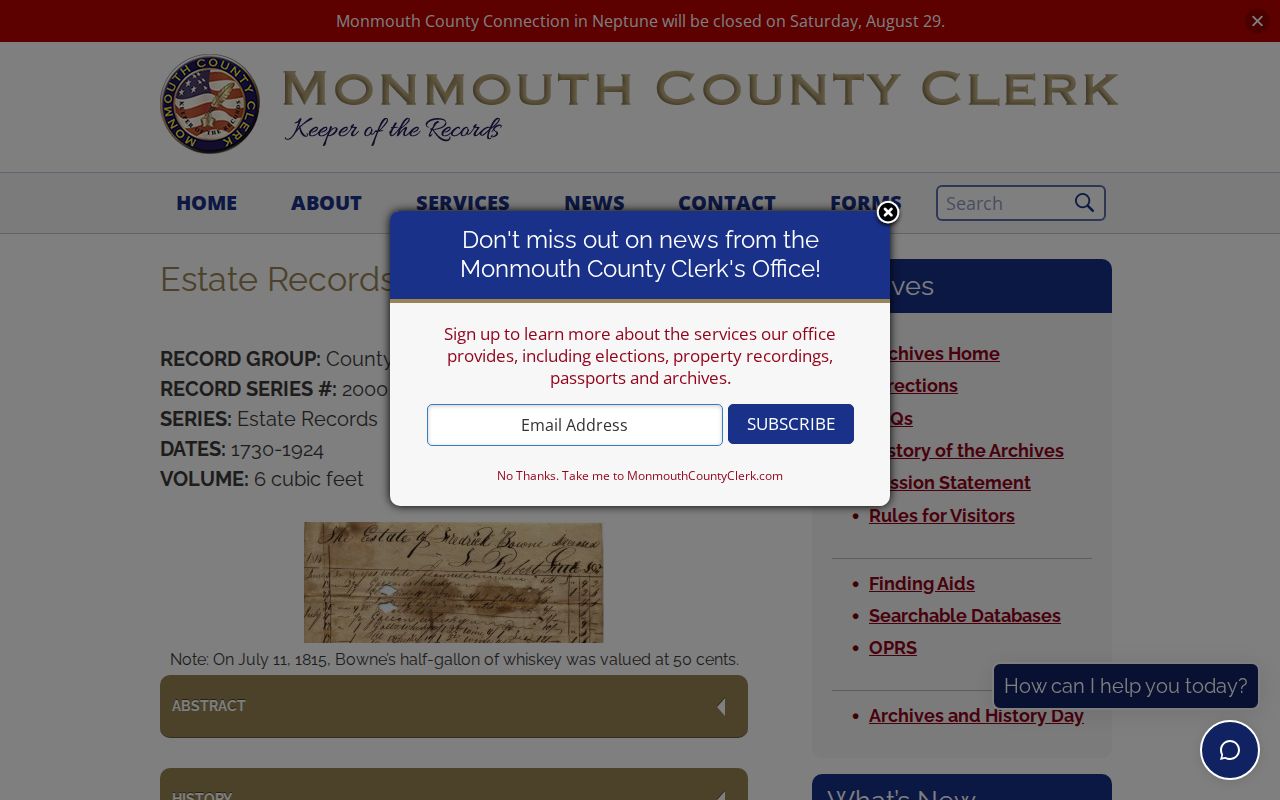
The County Archives’ Estate Records 1739-1924 collection covers 179 intestate individuals, mostly between 1807 and 1844. The twelve original manuscript boxes were not microfilmed and are arranged alphabetically by the deceased person. They can contain inventories, receipts, buyers, creditors, appraisals, administrators, and occasional deeds or judgments. For later probate, use the Monmouth Surrogate, whose computerized directory begins in mid-1991 and whose Russell Index covers estimated years 1798 through 1991.
A view of the County Archives estate-records series shows the historic collection that can connect a deceased owner or purchaser to a dated property trail.
Estate paperwork identifies a relationship to an estate at the time of administration. An heir, administrator, buyer, or creditor should not be assumed to have lived at the older Howell address without a separate address record.
Howell Past Residents Map Gaps
Maps can date a building or explain a tract, but they need careful local matching. The New Jersey Sanborn collection includes maps for many cities from 1884 into the early 1950s, and a nearby Freehold example is dated January 1885. No Howell-specific Sanborn run or year was located in the official open search. A Freehold sheet must not be treated as proof that a Howell address appears on it.
Instead, pair a confirmed Howell tax map, map sheet, plat, and legal description with the Library of Congress house-history method and local repository research. Permit dates and tax-list changes can bracket construction or alteration, but Howell’s open-permit response excludes closed permits. Request a specific older file through the correct municipal channel when the date matters.
Howell Previous Residents Locality Changes
Historic names and municipal boundaries can redirect the search. Jerseyville was Green Grove before its 1854 name change. The Township history also links Southard and Bethel, while historic records may use rural routes or post-office labels. In the Pine View and Ramtown area, about 58 acres shifted from Wall Township to Howell around 2003. A former Wall description can therefore belong to a parcel now administered by Howell.
Search the historic locality, present municipality, old lot, and legal description together. The goal is not to modernize the older record’s wording, but to prove that the record and present parcel meet at the same documented property. This geography check is often what resolves an apparent gap between a deed trail and the household sources.
Howell Previous Residents Privacy
Past residents research is strongest when it stays dated and document-based. Recorded ownership, historic directory entries, census households, and estate relationships may concern different people and different years. New Jersey protects certain address and identification information, and public records do not provide a complete household list. Do not infer a living person’s location from a deceased relative, an old census entry, a private utility account, or a redacted record.
Lawful personal use. Use a Howell address trail for family history, property history, estate questions, and personal research. Do not use records to stalk, harass, intimidate, or harm anyone, and respect records that are sealed, redacted, or safety protected.
When a record is missing, request the specific document from the custodian, make a library or archives appointment, or record the uncertainty. A missing result is a reason to check the coverage and identifier, not to expand the search into private personal information.